
What your brain has evolved to do is…
What your brain has evolved to do is…
…at multiple levels (in multiple activities) try to anticipate the world.
…at multiple levels (in multiple activities) try to anticipate the world.
March 1, 2026
March 1, 2026
This is the core idea of predictive processing.
And if it can explain that anticipatory ability, it’s explaining a lot of what makes you generally intelligent.
Now, we can translate some of that functional language:
What is it doing? It's trying to anticipate the world.
Into the phenomenological language:
How are you experiencing it? The brain is actually trying to reduce surprise.
The brain is trying to reduce you being surprised by the environment.
Surprises are prediction errors.
It means your expectations have not been met.
So phenomenologically what we're talking about is:
You have expectations and they're not met…and that's a prediction error and you're trying to reduce that.
But you want to be surprised sometimes…because you don't want to just exploit where you are, you want to explore where you're not.
We're going to come back to that.
So the brain is trying to detect and complete ahead of the world patterns relevant to it.
And you experience that in a particular way.
You experience that as a kind of not being surprised and that your expectations are continually being met.
So when you get up to walk across the floor, you expect that the floor will be solid, that you'll be able to go there, etc.
And if the floor starts to break, then you are surprised.
All that sounds easy, but predicting the world is really hard.
Think about all the scientists we need with all of their education, banded together using computers and machines…and all this to make their predictions.
Now, the first major insight I'll give you into predictive processing is how it tries to address this issue that predicting the world is so hard. So let's try and unpack it a little bit more.
Why is the world so hard to predict?
Well, it's really large…and I don't just mean spatially big.
The world contains way more in it than you can realize…way, way more.
The world isn't simple. It's complex. And what's annoying about it is, it keeps getting more complex.
Especially if you're in a world where there's a cultural, technological environment like the one we're in.
It's constantly changing and the information we get from it is almost always ambiguous.
There are multiple possible interpretations of it.
Behind that is the deep reason:
The world is not trying to communicate with us.
It is not trying to cooperate with us. It is not trying to be clear to us.
And that means there are a lot of ways we can go wrong.
Now, stick with me….this is a little abstract, and I'll do it a couple of different ways:
Let's say it's just non-controversial that the amount of information I can take in at any time, even my entire lifetime from the world, is finite.
I have a finite amount of data.
There is a technical, mathematical, logically and deductively valid proof (that comes from Reichenbach and other philosophers) that for any finite set of data, there is literally an infinite number of legitimate (meaning logically consistent) interpretations of it.
That's a problem.
Now that was very top-down and abstract…let's do it in a more concrete, bottom-up way:
Imagine that all the world was doing was just generating a single stream of figures for you.
And these patterns are complex. They're ongoing. They're changing on the fly…and you already know they're just going to be very, very, very big.
So you start to look at this:
There's a 1 and a 2 that show up….what's next?
3, maybe?
Or maybe it's doubling.
Maybe it goes 1, 2, 4.
Maybe it alternates between primes and not primes.
Don't know.
This is what Kirchhoff means by underdetermination.
That thing I just did is called the underdetermination problem.
The data don't determine which interpretation you should make. It's underdetermined.
You're too unconstrained in your attempt to interpret it.
So you say, well, I need more information:
But now there's a 1, 2, 4, and then a letter B.
Now, what's next?
And then it goes 1, 2, 4, B, 2, B.
What's next?
And now you move to the next pattern…and the number 1 has disappeared.
Now it's 2, 4, B, 2, B.
What's next now?
And then it goes 2, 4, B, 2, B…is the next thing another B or a 6?
You can’t tell.
That's what it's really like…and you don't realize that because your brain is so good at solving this problem.
This is the core idea of predictive processing.
And if it can explain that anticipatory ability, it’s explaining a lot of what makes you generally intelligent.
Now, we can translate some of that functional language:
What is it doing? It's trying to anticipate the world.
Into the phenomenological language:
How are you experiencing it? The brain is actually trying to reduce surprise.
The brain is trying to reduce you being surprised by the environment.
Surprises are prediction errors.
It means your expectations have not been met.
So phenomenologically what we're talking about is:
You have expectations and they're not met…and that's a prediction error and you're trying to reduce that.
But you want to be surprised sometimes…because you don't want to just exploit where you are, you want to explore where you're not.
We're going to come back to that.
So the brain is trying to detect and complete ahead of the world patterns relevant to it.
And you experience that in a particular way.
You experience that as a kind of not being surprised and that your expectations are continually being met.
So when you get up to walk across the floor, you expect that the floor will be solid, that you'll be able to go there, etc.
And if the floor starts to break, then you are surprised.
All that sounds easy, but predicting the world is really hard.
Think about all the scientists we need with all of their education, banded together using computers and machines…and all this to make their predictions.
Now, the first major insight I'll give you into predictive processing is how it tries to address this issue that predicting the world is so hard. So let's try and unpack it a little bit more.
Why is the world so hard to predict?
Well, it's really large…and I don't just mean spatially big.
The world contains way more in it than you can realize…way, way more.
The world isn't simple. It's complex. And what's annoying about it is, it keeps getting more complex.
Especially if you're in a world where there's a cultural, technological environment like the one we're in.
It's constantly changing and the information we get from it is almost always ambiguous.
There are multiple possible interpretations of it.
Behind that is the deep reason:
The world is not trying to communicate with us.
It is not trying to cooperate with us. It is not trying to be clear to us.
And that means there are a lot of ways we can go wrong.
Now, stick with me….this is a little abstract, and I'll do it a couple of different ways:
Let's say it's just non-controversial that the amount of information I can take in at any time, even my entire lifetime from the world, is finite.
I have a finite amount of data.
There is a technical, mathematical, logically and deductively valid proof (that comes from Reichenbach and other philosophers) that for any finite set of data, there is literally an infinite number of legitimate (meaning logically consistent) interpretations of it.
That's a problem.
Now that was very top-down and abstract…let's do it in a more concrete, bottom-up way:
Imagine that all the world was doing was just generating a single stream of figures for you.
And these patterns are complex. They're ongoing. They're changing on the fly…and you already know they're just going to be very, very, very big.
So you start to look at this:
There's a 1 and a 2 that show up….what's next?
3, maybe?
Or maybe it's doubling.
Maybe it goes 1, 2, 4.
Maybe it alternates between primes and not primes.
Don't know.
This is what Kirchhoff means by underdetermination.
That thing I just did is called the underdetermination problem.
The data don't determine which interpretation you should make. It's underdetermined.
You're too unconstrained in your attempt to interpret it.
So you say, well, I need more information:
But now there's a 1, 2, 4, and then a letter B.
Now, what's next?
And then it goes 1, 2, 4, B, 2, B.
What's next?
And now you move to the next pattern…and the number 1 has disappeared.
Now it's 2, 4, B, 2, B.
What's next now?
And then it goes 2, 4, B, 2, B…is the next thing another B or a 6?
You can’t tell.
That's what it's really like…and you don't realize that because your brain is so good at solving this problem.
John Vervaeke
John Vervaeke
Latest Course
Daemons in Divinity
An Interdisciplinary Study on the Daemon
Latest Course
Daemons in Divinity
An Interdisciplinary Study on the Daemon
Latest Course
Daemons in Divinity
An Interdisciplinary Study on the Daemon
More insights for you.
More insights for you.
Explore more of the science and philosophy here.
Explore more of the science and philosophy here.

The brain is actually not directly predicting the world like we do in science...
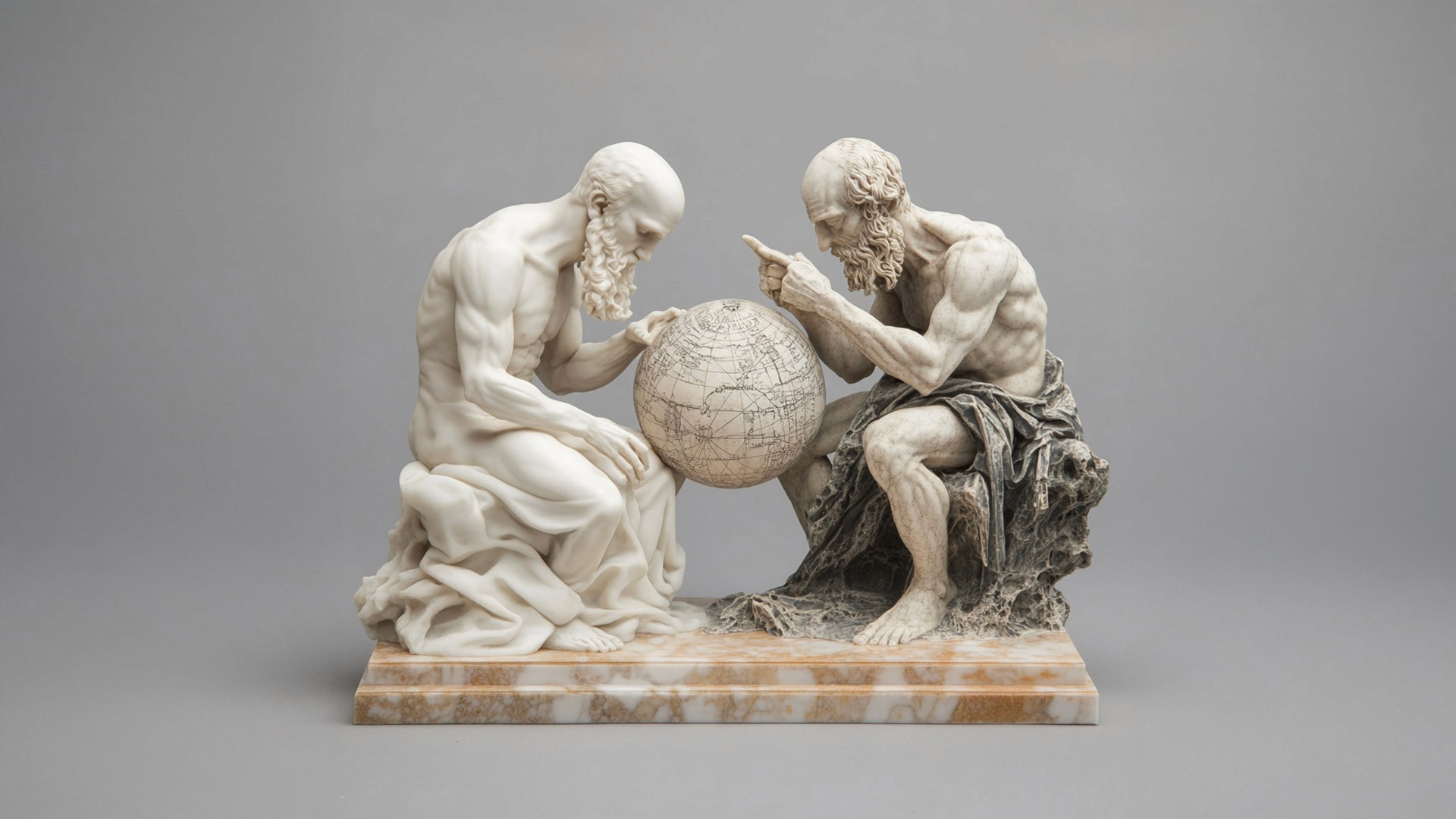
Our capacity for learning and solving problems so that we know things is called intelligence.
Our capacity for learning and solving problems so that we know things is called intelligence.
Your questions.
Answered.
Not sure what to expect? These answers might help you feel more confident as you begin.
Didn’t find your answer? Send us a message — we’ll respond with care and clarity.
What if I’m not familiar with philosophy or science?
Yes! Our courses are designed to be accessible to both beginners and those with experience. John will hold a seminar after each lecture to answer any questions you might have.
What if I’m not familiar with philosophy or science?
Yes! Our courses are designed to be accessible to both beginners and those with experience. John will hold a seminar after each lecture to answer any questions you might have.
Do I need to have specific religious or scientific beliefs to benefit from the course?
Do I need to have specific religious or scientific beliefs to benefit from the course?
No. The courses are open to everyone, regardless of religious or scientific background. It’s about exploring diverse perspectives and finding a way to integrate them into your life.
Will this course challenge my current beliefs?
Will this course challenge my current beliefs?
Yes, the course is designed to provoke deep reflection. It introduces perspectives that will encourage you to question and reconsider long-held beliefs, fostering growth and deeper understanding.
I’m worried I won’t understand the material. Is it too advanced?
I’m worried I won’t understand the material. Is it too advanced?
Not at all! The course breaks down complex ideas into simple, easy-to-understand concepts, ensuring that whether you’re new to philosophy or well-versed, you’ll gain valuable insights.
What if I can’t attend live sessions or keep up with the pace?
What if I can’t attend live sessions or keep up with the pace?
All materials, including live session recordings, will be available to you anytime. You can go through the content at your own pace, fitting it around your schedule.
Is there any interaction with the instructor or other students?
Is there any interaction with the instructor or other students?
Yes! You will have the opportunity to engage with John and fellow students throughout the course.
Your questions.
Answered.
Not sure what to expect? These answers might help you feel more confident as you begin.
What if I’m not familiar with philosophy or science?
Yes! Our courses are designed to be accessible to both beginners and those with experience. John will hold a seminar after each lecture to answer any questions you might have.
What if I’m not familiar with philosophy or science?
Yes! Our courses are designed to be accessible to both beginners and those with experience. John will hold a seminar after each lecture to answer any questions you might have.
Do I need to have specific religious or scientific beliefs to benefit from the course?
Do I need to have specific religious or scientific beliefs to benefit from the course?
No. The courses are open to everyone, regardless of religious or scientific background. It’s about exploring diverse perspectives and finding a way to integrate them into your life.
Will this course challenge my current beliefs?
Will this course challenge my current beliefs?
Yes, the course is designed to provoke deep reflection. It introduces perspectives that will encourage you to question and reconsider long-held beliefs, fostering growth and deeper understanding.
I’m worried I won’t understand the material. Is it too advanced?
I’m worried I won’t understand the material. Is it too advanced?
Not at all! The course breaks down complex ideas into simple, easy-to-understand concepts, ensuring that whether you’re new to philosophy or well-versed, you’ll gain valuable insights.
What if I can’t attend live sessions or keep up with the pace?
What if I can’t attend live sessions or keep up with the pace?
All materials, including live session recordings, will be available to you anytime. You can go through the content at your own pace, fitting it around your schedule.
Is there any interaction with the instructor or other students?
Is there any interaction with the instructor or other students?
Yes! You will have the opportunity to engage with John and fellow students throughout the course.
Didn’t find your answer? Send us a message — we’ll respond with care and clarity.
Your questions.
Answered.
Not sure what to expect? These answers might help you feel more confident as you begin.
Didn’t find your answer? Send us a message — we’ll respond with care and clarity.
What if I’m not familiar with philosophy or science?
Yes! Our courses are designed to be accessible to both beginners and those with experience. John will hold a seminar after each lecture to answer any questions you might have.
What if I’m not familiar with philosophy or science?
Yes! Our courses are designed to be accessible to both beginners and those with experience. John will hold a seminar after each lecture to answer any questions you might have.
Do I need to have specific religious or scientific beliefs to benefit from the course?
Do I need to have specific religious or scientific beliefs to benefit from the course?
No. The courses are open to everyone, regardless of religious or scientific background. It’s about exploring diverse perspectives and finding a way to integrate them into your life.
Will this course challenge my current beliefs?
Will this course challenge my current beliefs?
Yes, the course is designed to provoke deep reflection. It introduces perspectives that will encourage you to question and reconsider long-held beliefs, fostering growth and deeper understanding.
I’m worried I won’t understand the material. Is it too advanced?
I’m worried I won’t understand the material. Is it too advanced?
Not at all! The course breaks down complex ideas into simple, easy-to-understand concepts, ensuring that whether you’re new to philosophy or well-versed, you’ll gain valuable insights.
What if I can’t attend live sessions or keep up with the pace?
What if I can’t attend live sessions or keep up with the pace?
All materials, including live session recordings, will be available to you anytime. You can go through the content at your own pace, fitting it around your schedule.
Is there any interaction with the instructor or other students?
Is there any interaction with the instructor or other students?
Yes! You will have the opportunity to engage with John and fellow students throughout the course.