

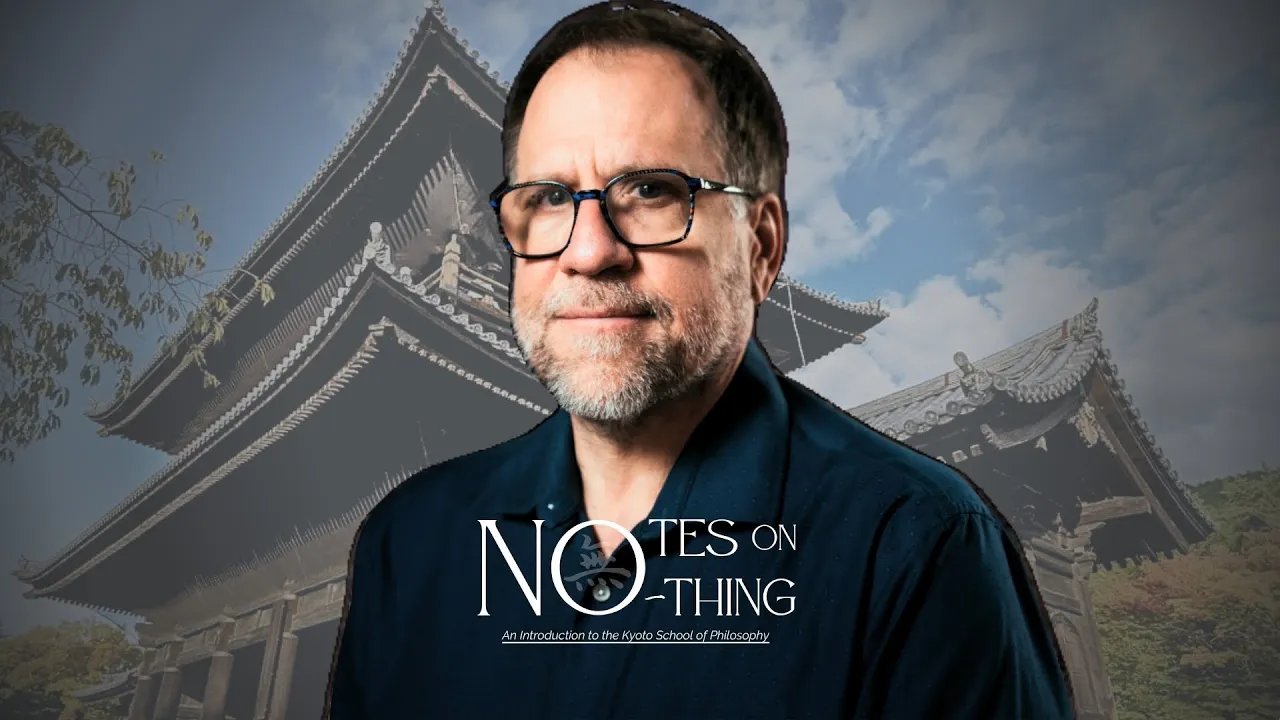

What if this sense of emptiness is actually an aperture, a new way of seeing into the depth of reality?
That reality is ultimately a no-thing and that you just haven’t gone deep enough with your nihilism, to the depths of your grief…whereby grief is not just the loss of a person, it’s the loss of a particular way of getting access to reality.
Let’s look at the following:
If you try to fill the void from personal loss with substitutes (drugs, sex, rebound relationships, distractions, etc.) you will suffer.
But if instead you grow (so it’s not so large in your psyche) and you reorient behind the grief, it becomes a way in which you can look deeply into other people's suffering.
You get to realize the depths of people that were otherwise not accessible to you.
In a similar way, if you deeply enough grieve nihilism, it becomes an aperture by which you can undergo the ability to see more deeply into the depths of reality.
And some philosophical traditions have gone directly into this abyss…
The Kyoto School of Philosophy is one such tradition.
The Kyoto school is a diverse group of Japanese thinkers who share the goal of integrating Western Philosophy (especially the work of thinkers such as James, Tillich, and Heidegger) with Japanese thought (especially Zen Buddhism and Pure Land Buddhism).
What came out of their scholarship confronts nihilism at its deepest level…as a gateway to transformation through nothingness, emptiness, and self-overcoming.
And in that sense you couldn’t ask for a better dialogical partner for trying to bring about a mutual liberation from the straitjackets of narcissism and nihilism.
Why?
Because their narcissism isn’t an individual narcissism…it’s a collectivist, militaristic, nationalistic narcissism.
And their nihilism is born out of a collapse of a religious framework...but it’s not post-Christian.
So our cultures share structural similarities, but they are also fundamentally different…which is exactly what you need for a good dialogical relationship.
Course Curriculum
The Overall Orientation of The Kyoto School
Nishida and the Philosophy of Pure Experience and basho
Nishida and the Philosophy of Pure Experience and basho (cont'd)
Tanabe and Philosophy as Metanoetics
Tanabe and Philosophy as Metanoetics (cont'd)
Nishitani and Religion, Nothingness, and the Overcoming of Nihilism
Nishitani and Religion, Nothingness, and the Overcoming of Nihilism (cont'd)
The Kyoto school, The Meaning Crisis, The Advent of the Sacred, and Zen Neoplatonism

FAQ
Are these courses like other online philosophy or spirituality courses?
Not exactly. These courses are not designed as content dumps or self-help programs. They are structured learning journeys that integrate philosophy, cognitive science, history, and spirituality to cultivate deeper understanding, clearer sense-making, and existential relevance, not hacks or techniques.
Do I need prior background in philosophy, cognitive science, or religion?
No formal background is required. The courses are carefully scaffolded and assume curiosity rather than expertise. If you’re willing to read attentively, reflect seriously, and sit with difficult questions, you’ll be able to engage the material meaningfully.
Are these courses practical, or purely theoretical?
They are intellectually rigorous, but never merely abstract. Each course is oriented toward how ideas shape perception, meaning, identity, and lived experience. While these are not “how-to” programs, they are a conceptual foundation for practice, transformation, and orientation in life.
Is this therapy or spiritual direction?
No. These courses are educational and philosophical in nature. They may be personally challenging and transformative, but they are not therapy, pastoral counseling, or clinical intervention. Growth here comes through understanding, dialogue, and reflection.
How much time should I expect to commit?
Most courses are designed to be manageable alongside work or study. Expect time for watching lectures, doing assigned readings (where applicable), and reflective integration. The depth you get out of the course will largely reflect the care you bring to it.
Are these courses connected to one another, or can I take them independently?
Each course stands on its own, but they are also part of a larger, coherent intellectual and pedagogical arc across The Lectern. Many learners find that taking multiple courses deepens understanding as ideas recur, evolve, and interconnect across contexts.
Will this challenge my beliefs?
Possibly. These courses do not aim to persuade you toward a particular ideology or worldview, but they do invite you to examine assumptions, inherited frameworks, and habitual ways of making meaning. Challenge here is a feature, not a flaw.